Journals
-

Jurnal Pilar Nusa Mandiri
The Pilar Nusa Mandiri : Journal of Computing and Information System Journal is a formation of the Information Systems study program, which was originally a medium for accommodating scientific writings of Universitas Nusa Mandiri Jakarta Information Systems lecturers. Along with the times, this journal has become a National journal that has P-ISSN: 1978-1946 and E-ISSN: 2527-6514. Pilar Nusa Mandiri : Journal of Computing and Information System has become a Rank 5 Accredited Journal and is trying to become a higher accredited journal. Pilar Nusa Mandiri : Journal of Computing and Information System is published 2 times in 1 year, namely in March and September. This journal is Rank 5 Accreditation Certificate (S5), Accreditation is valid for 5 years. Starting from Vol. 19, No. 2 the Year 2023 to Vol. 24, No. 1 the Year 2028 based on the Decree of the Minister of Research and Technology / National Research and Innovation Agency Number 0173 / C3 / DT.05.00 / 2025, March 21, 2025.
-

Jurnal Techno Nusa Mandiri
TECHNO Nusa Mandiri: Journal of Computing and Information Technology is a journal published by LPPM Universitas Nusa Mandiri. The TECHNO Nusa Mandiri: Journal of Computing and Information Technology was originally intended to accommodate scientific papers made by Informatics Engineering lecturers. TECHNO Nusa Mandiri Journal has ISSN: 1978-2136 (Print Media) and 2527-676X (Online Media). The TECHNO Nusa Mandiri: Journal of Computing and Information Technology have the accredited National Journal status is accredited by the Indonesian Ministry of Research and Higher Education at the Sinta S4 level, in accordance with Decree on Strengthening SK Research and Development Number 21 / E / KPT / 2018 which has been in effect since July 9, 2018, for 5 years. Source: Risbang Ristekdikti.go.id. This journal is Rank 4 Accreditation Certificate (S4), Accreditation is valid for 5 years. Starting from Vol. 13, No. 1 the Year 2016 to Vol. 17, No. 1 the Year 2020. Journal of TECHNO Nusa Mandiri, re-accreditation remains at Rank 4 (SINTA 4), starting Vol. 16 No. 2 of 2019 based on the Decree of the Minister of Research and Technology / National Research and Innovation Agency Number 85/M/ KPT/2020, April 1, 2020
-

JITK (Jurnal Ilmu Pengetahuan dan Teknologi Komputer)
JITK (Jurnal Ilmu Pengetahuan dan Teknologi Komputer) Nusa Mandiri is a scientific journal containing research results written by lecturers, researchers, and practitioners who have competencies in the field of computer science and technology. This journal is expected to develop research and provide meaningful contributions to improve research resources in the fields of Information Technology and Computer Science. JITK is published by the University of Nusa Mandiri Research Center in open access and free. Each published article has a digital object identifier (DOI): Prefix: 10.33480. The JITK journal has obtained an accreditation value for the SINTA 2, to send scientific articles to JITK, first read the article shipping instructions at the next link. P-ISSN: 2685-8223 & E-ISSN: 2527-4864
-

INTI Nusa Mandiri
Jurnal INTI Nusa Mandiri merupakan jurnal yang diperuntukan keilmuan Computer science (Ilmu Komputer). kajian keilmuan mencakupi tentang komputasi, perangkat lunak (software). Ilmu komputer mencakup beragam topik yang berkaitan dengan komputer, mulai dari analisis data science, algoritma sampai subyek yang lebih konkret seperti bahasa pemrograman, perangkat lunak. Ilmu Komputer lebih menekankan pada pemrograman komputer, dan rekayasa perangkat lunak (software), pemrograman science
Jurnal INTI Nusa Mandiri terakreditasi SINTA 4 dan memiliki P-ISSN: 0216-6933 (Media Cetak), E-ISSN: 2685-807X (Media Onlie). Jurnal INTI Nusa Mandiri terbit 1 (satu) tahun sebanyak 2 (dua) kali terbit, pada bulan Februari dan Agustus.
-

Jurnal AbdiMas Nusa Mandiri
Jurnal AbdiMas Nusa Mandiri merupakan Jurnal Pengabdian Kepada Masyarakat Nusa Mandiri adalah wadah untuk mempublikasikan hasil pengabdian kepada masyarakat dari para insan akademisi, praktisi dan lainnya yang bergerak di berbagai bidang keilmuan (multidisiplin ilmu). Jurnal AbdiMas Nusa Mandiri memiliki P-ISSN: 2774-5007 | E-ISSN: 2774-499X dan menerbitkan dan dikelola secara profesional oleh Lembaga Penelitian dan Pengabdian Masyarakat Universitas Nusa Mandiri. Jurnal AbdiMas Nusa Mandiri yang menampung manuskrip di tingkat nasional yang mencakup banyak masalah umum atau masalah yang terkait dengan layanan masyarakat. Tujuan dari publikasi jurnal ini adalah untuk menyebarluaskan pemikiran konseptual atau ide dan hasil penelitian yang telah dicapai di bidang layanan masyarakat.
-
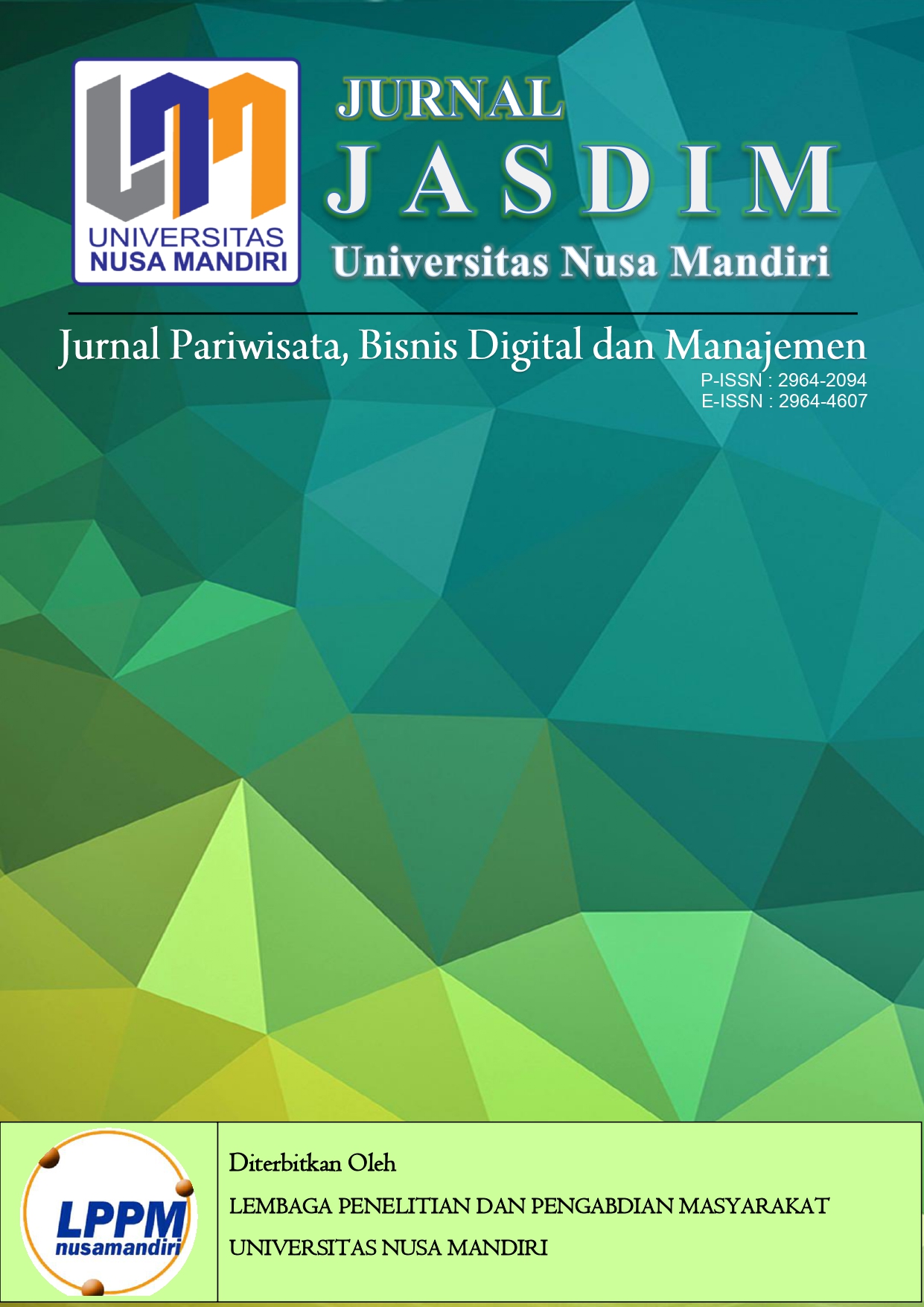
Jurnal Pariwisata Bisnis Digital dan Manajemen
Jurnal Pariwisata, Bisnis Digital dan Manajemen adalah jurnal yang diterbitkan oleh Lembaga Penelitian dan Pengabdian Masyarakat Universitas Nusa Mandiri, Indonesia. Jurnal Pariwisata, Bisnis Digital dan Manajemen yang memiliki akronim JASDIM, merupakan jurnal yang diperuntukan dalam bidang keilmuan ekonomi dan bisnis yang mencakup terkait pengetahuan dan wawasan pengembangan manajemen dan bisnis khususnya di Indonesia. Adapun kajian keilmuan artikel pada Jurnal Pariwisata, Bisnis Digital dan Manajemen diantaranya diperuntukan untuk bidang ilmu manajemen, bisnis digital dan pariwisata atau perhotelan. Tujuan utama pada jurnal ini yaitu sebagai wadah penyebarluasan artikel ilmiah dibidang Ekonomi dan Bisnis yang bersifat terbuka untuk mahasiswa, peneliti ataupun akademisi baik dilingkungan internal Universitas Nusa Mandiri dan juga eksternal Universitas Nusa Mandiri. Jurnal Pariwisata, Bisnis Digital dan Manajemen diterbitkan oleh LPPM Universitas Nusa Mandiri menggunakan dua bahasa yaitu bahasa Indonesia dan bahasa bahasa Inggris dengan memiliki P-ISSN : 2964-2094 dan E-ISSN: 2964-4607 , Jurnal Pariwisata, Bisnis Digital dan Manajemen telah terindeks oleh Google Scholar dan GARUDA (Garba Rujukan Digital). serta terbit sebanyak 2 kali dalam 1 tahun pada bulan Mei dan bulan November.
